

New paper in JACS
10 07 2026
Category: Publications
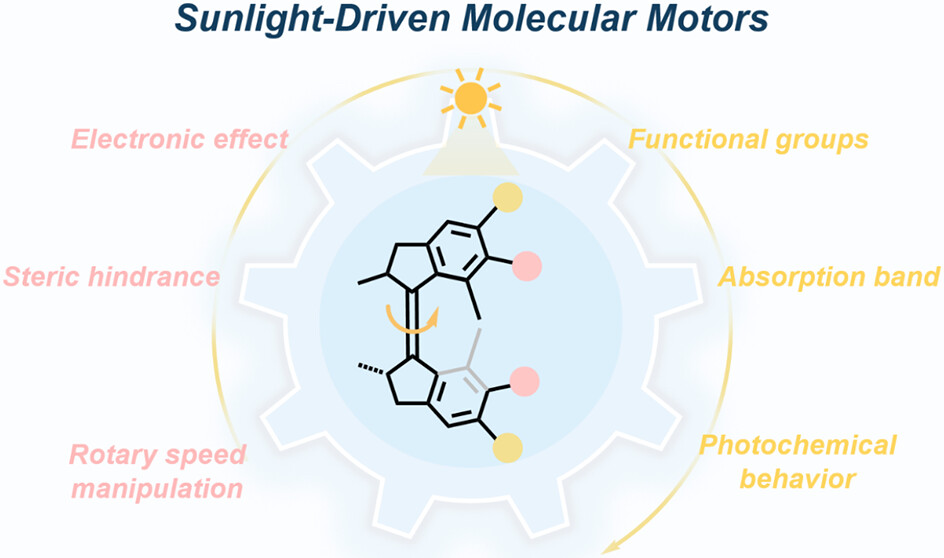
Check out our new paper in the journal JACS. In a collaborative study, Dr Wojciech Danowski, alongside with team from the University of Groningen (The Netherlands) and the Soochow University (China), describes a new strategy for designing highly efficient visible-light-driven molecular motors.
Engineering Highly Photoefficient and Function-Tunable Molecular Rotary Motors toward Sunlight Responsiveness
Journal of the American Chemical Society, 2026, 148, 24, 25012–25022, DOI: 10.1021/jacs.6c05225
Molecular motors are among the most advanced examples of molecular machines — molecules capable of performing controlled molecular motion and work. Light-driven systems are of particular importance, as they enable remote, precise, and non-invasive control of motion at the level of individual molecules. Such systems are being intensively studied as components of future adaptive materials, nanotechnology, and dynamic molecular systems.
In the published work, the authors present a library of first-generation molecular motors with high photoisomerization quantum yields and diverse functionality. The key concept was to use chemical reactions that allow modification of the classical molecular motor scaffold at a late stage of synthesis. This made it possible to systematically investigate how subtle structural changes affect the photochemical properties, functionalization potential, and rotational rates of these systems. The study showed that appropriately selected functional groups make it possible to precisely regulate the operation of molecular motors. A particularly important result was the identification of para-formylation as an effective design principle leading to a significant increase in the photoefficiency of these systems. The motors exhibit very high sensitivity to ambient sunlight, both in solution and after incorporation into a polymer matrix.
These results open up new opportunities for designing highly efficient molecular motors with tailored functions, which may find applications in advanced light-responsive materials. The work expands the synthetic “toolbox” of molecular machine chemistry and points to practical directions for the further design of systems capable of operating efficiently under natural illumination.
The research was supported, among others, by the Polish National Agency for Academic Exchange under the Polish Returns programme grant BPN/PPO/2023/1/00014 and by the National Science Centre under the Research Component grant 2024/03/1/ST5/00003.