



New paper in ACS Biomaterials Science & Engineering
02 05 2026
Category: Publications
Check out our new paper in the journal ACS Biomaterials Science & Engineering. In a collaborative study, our colleagues Dr Agnieszka Krogul-Sobczak and Dr Piotr Piotrowski, alongside an interdisciplinary team from the University of Rzeszów, the Łukasiewicz Research Network, the Silesian University of Technology, and the University of Silesia in Katowice, have explored new frontiers in nanomedicine.
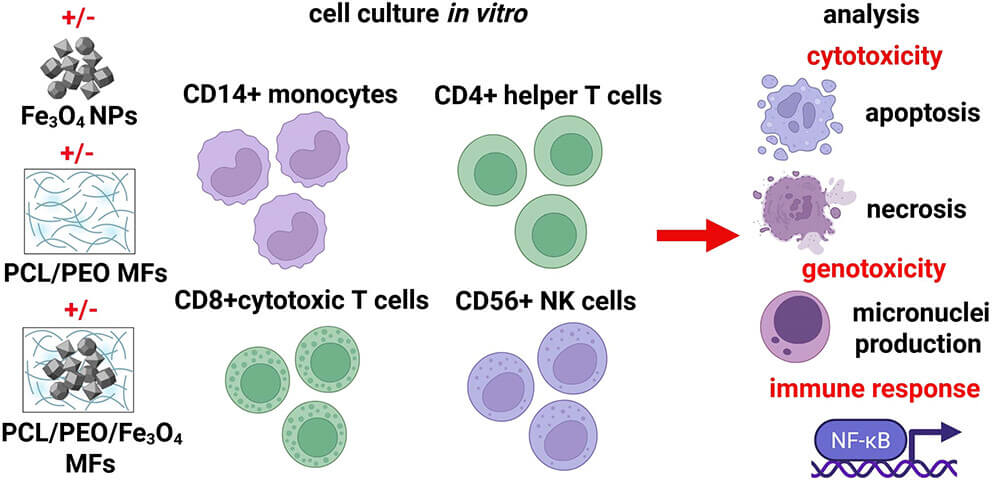
Fabrication of Electrospun PCL/PEO Microfibers with Fe3O4 Nanoparticles for Magnetic Hyperthermia: Immunocompatibility Assessment Using CD14+ Monocytes, CD4+ and CD8+ T Cells, and CD56+ NK Cells In Vitro
ACS Biomaterials Science & Engineering 2026, DOI: 10.1021/acsbiomaterials.5c02218
The research focuses on developing novel strategies for the surface modification of magnetite nanoparticles (Fe3O4 NPs) to improve their biocompatibility for advanced biomedical applications, such as magnetic hyperthermia. By utilizing the electrospinning method, the team successfully fabricated composite microfibers made of poly(ε-caprolactone) (PCL) and poly(ethylene oxide) (PEO) containing these magnetic nanoparticles. The study provides a comprehensive evaluation of the physicochemical properties and magnetically induced hyperthermia effects of these PCL/PEO/Fe3O4 microfibers compared to traditional nanoparticles.
A significant portion of the work involved assessing the biocompatibility and immunocompatibility of the materials using four types of human immune cells: CD14+ monocytes, CD4+ helper T cells, CD8+ cytotoxic T cells, and CD56+ NK cells. While the microfibers did not lower the viability of normal human fibroblasts, the researchers discovered that monocytes were the most sensitive to the treatment. Furthermore, a mild immunogenic response was revealed in helper T cells through the analysis of transcriptional activity of 92 genes involved in the NFκB pathway. These elevated mRNA levels of specific genes like NFKB2, TNF, and TRAF1 suggest context-dependent immunomodulatory effects that are essential to consider when designing next-generation drug-delivery systems based on PCL/PEO and Fe3O4 NPs.